What A Sequatchie County Land Listing Actually Costs: Reading Past The Median Price Per Acre
August 6, 2026
August 6, 2026
The portals will tell you Sequatchie County land runs somewhere between $8,000 and $20,000 an acre. That is a real number and also a nearly useless one. Two parcels a mile apart, both listed at $15,000 an acre, can be a $60,000 gap in what you actually spend to put a house on the ground.
The gap has a source, and it is not scenery or road frontage. It is the quiet fact that in Sequatchie County, most of the buildability risk you would expect a permit office to catch has been pushed downstream onto the buyer. Once you understand what that means, the listings start to read very differently.
Start with the piece of local practice that surprises almost every out-of-market buyer. According to the Sequatchie County Assessor of Property, the county does not require building permits. Some utility providers require permits for electrical and septic hookups, and the City of Dunlap does require permits inside city limits, but for the acreage tracts most buyers are shopping, there is no county building department reviewing your plans before you pour a footer.
That sounds like freedom. In practice it is a transfer of responsibility. When a county issues permits, its plan reviewers are catching problems on the front end: setbacks, floodplain conflicts, septic-to-well distances, drain-field feasibility. When a county doesn't, those checks still exist under state law, but the burden of triggering them lands on the buyer and the buyer's team. If you skip a step during due diligence, no one at a county counter is going to stop you. You will discover the problem on the day you try to close a construction loan, or worse, on the day the drain field fails.
That is the mechanism the median price per acre cannot show you. A "cheap" parcel where the seller has done none of the work carries a hidden bill. A "premium" parcel in a gated community where the developer has already run soil evaluations, extended fiber, and stubbed utilities to the lot line has already paid that bill for you.
Look at what different land data sites report for Sequatchie County right now:
The spread is not an error. Each provider is measuring a different animal. Sold prices skew toward large recreational tracts that trade in bulk at low per-acre numbers. Ten-plus-acre asking prices strip out the small building lots that pull the average up. Full active inventory includes those small platted lots inside developments, where a buildable acre carries a premium that has nothing to do with the dirt and everything to do with the road, the power line, and the covenants.
If you are pricing a 60-acre timber tract against sold comps, the $8,437 number is closer to reality. If you are pricing a 3-acre lot in a gated community against sold comps, you are looking at the wrong dataset entirely. Bring the right ruler.
What a Sequatchie County parcel actually costs to make habitable depends on a stack of four inputs. Move up the stack, the listing price rises and the after-purchase spend falls. Move down the stack, the listing price falls and the after-purchase spend rises to meet it. The total is roughly a wash. The distribution is what changes.
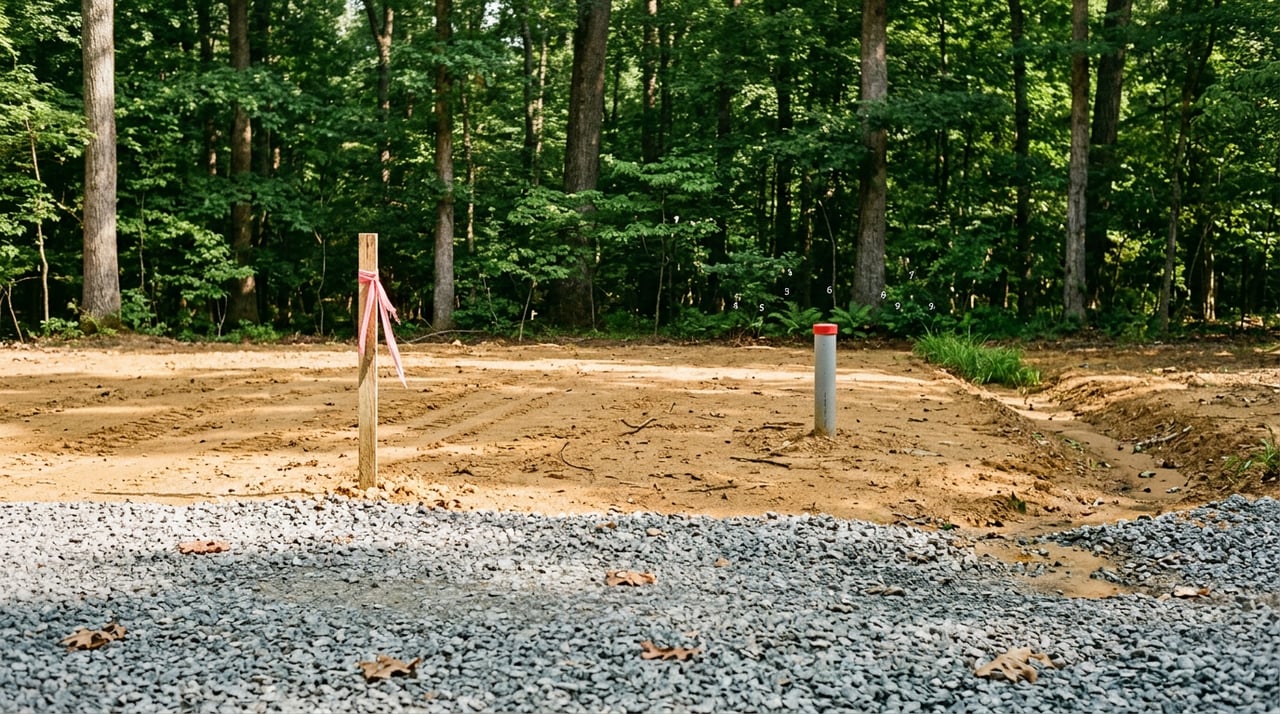
Tier one, raw acreage. No utilities at the road, no soil work, no covenants. This is the $8,000-per-acre end. You will pay for a driveway cut, a well or a water line extension, power drops from the pole, and a full soil evaluation before you know whether the parcel supports a three-bedroom system or a one-bedroom.
Tier two, road-frontage lots with power available. The Whitwell and Graysville small-acreage listings in the county fall here. Electricity is at the road. Septic is still your problem, and language like "double-wide manufactured homes are permitted" is doing real work in the listing: it tells you the covenants are light, which is a plus if you want flexibility and a minus if you are worried about neighbor build quality.
Tier three, gated developments with utilities stubbed. This is where River Ridge Farms sits along the Sequatchie River near Dunlap. The listings there advertise power, water, gas, and internet already in place. The amenity set, canoe launch, riverfront pavilion, pool, clubhouse, playground, is the HOA's marketing surface, but the meaningful line item for a buyer is that the utility work is done. You are buying a lot you can actually break ground on, not a lot you have to develop before you can develop.
Tier four, large-scale planned nature developments. Fredonia Mountain Nature Resort is the anchor example: roughly 3,500 acres across five individually gated neighborhoods including Stone Creek, Greenfields Estates, and Bluff View, with a staffed main-entrance security office, a 14-acre private lake, and around 35 miles of trails and interconnected roadways. Listings inside FMNR routinely note electric, high-speed fiber, and water at the road, with septic still required by the buyer. Greenfields Estates carries a 2,200-square-foot minimum for single-story site-built homes and a 3,200-square-foot minimum for two-story. That covenant is the reason the neighbor's future home won't be a surprise, and it is also the reason the lot costs what it costs.
Because Sequatchie County doesn't run a building department, the single most important document attached to a parcel is not a permit. It is the soil evaluation.
Under Tennessee Code § 68-221-403, a subsurface sewage disposal permit requires that the lot's percolation rate be no more than 105 minutes per inch, that percolation holes be located on a 50-foot grid, and that the disposal field contain a minimum of 370 square feet of trench bottom area per bedroom. State rules also require a 100 percent reserve area: twice the usable ground for the drain field, so a replacement system can be installed if the first one fails.
That reserve requirement is what quietly disqualifies a lot of otherwise attractive parcels. A 3-acre lot with a beautiful pad on the flat and steep drop-offs everywhere else may only support a two-bedroom system, because there isn't enough contiguous usable soil to double up. That is why you see listings in the county carrying phrases like "county-pre-approved for 3 bedrooms" or "county-pre-approved for 2 bedrooms." The seller has already had the soil evaluated, and the parcel's ceiling on livable square footage has been set before you ever walk it.
If a listing doesn't specify a bedroom count the perc supports, treat that as a diligence item, not an oversight. On raw land the answer is almost never "as many as you want."
For any tract without an existing evaluation, the Tennessee Department of Environment and Conservation maintains a list of approved soil consultants, and the TDEC septic permit portal is where existing permits are searchable. Budget for the evaluation early. It is cheap relative to a closing, and it is the only real answer to what a Sequatchie County parcel is actually worth.
The listing copy in this market has a vocabulary worth learning. When you see these phrases, translate them:
The market is not standing still. According to Movoto's July 2026 data pull, Sequatchie's median list price was $270,000, a roughly 9 percent decrease year over year, with median price per square foot flat at $216. That softening is not evenly distributed. It is showing up most clearly in mid-tier improved homes and in the entry-price acreage tracts where sellers priced to 2024 comps and have watched days-on-market stretch out.
It is showing up least in the gated communities with utilities in the ground. Those listings have a real floor: the seller's cost basis includes infrastructure that would cost a new developer more to replicate today than it did to install five years ago. Sequatchie County is also running a 2026 Current Value Update through the Assessor's office, which will refresh assessed values on a schedule set by TCA 67-5-1601. Reassessments do not change tax bills mechanically, but they do change the paper baseline sellers point to during negotiation.
Do I need a building permit anywhere in Sequatchie County? Inside Dunlap city limits, yes, through Dunlap City Hall. Outside city limits, the county itself does not issue building permits, though septic permits through TDEC and utility permits from your provider are still required.
How much reserve area do I actually need for a septic system? Enough for a full replacement drain field. Tennessee's state rule is a 100 percent reserve, so you need roughly twice the drain-field footprint set aside on a soil-suitable part of the lot.
Can I finance raw land with no perc test? Sometimes, but construction lenders will condition the draw schedule on evidence of a viable septic plan, so getting the evaluation done during the option period is usually the cleanest path.
Is 0.45 percent really the property tax rate? Land.com references that figure, which is well below the national average. Verify current millage with the Sequatchie County Trustee before underwriting a hold; rates can shift with reappraisal cycles.
Buying land in this county rewards buyers who read past the headline number and price the stack instead of the acre. If you're weighing a specific parcel in Sequatchie County and want a second read on what the listing is really telling you, Melissa Hubbard brings a construction background to the walk-through and a clear-eyed take on what it will cost to build what you're picturing. Let's connect.
Stay up to date on the latest real estate trends.
Get assistance in determining the current property value, crafting a competitive offer, writing and negotiating a contract, and much more. Contact me today.